 Underground waste storage systems
 Underground waste storage systems are a modern solution for comprehensive and aesthetic waste management in urban environments. They allow containers to be hidden underground, reducing visual clutter and unpleasant odors in residential neighborhoods, commercial areas, and public spaces.
This approach meets the requirements of modern infrastructure and landscaping standards. Compared to above-ground bins, underground systems provide a higher level of sanitary conditions and improve the overall appearance of the urban environment.
Underground modules are equipped with a hydraulic lifting mechanism responsible for lowering and raising the platform with the containers. The use of a hydraulic drive increases reliability, process controllability, and equipment durability, which is a key factor for municipal services and private developers.
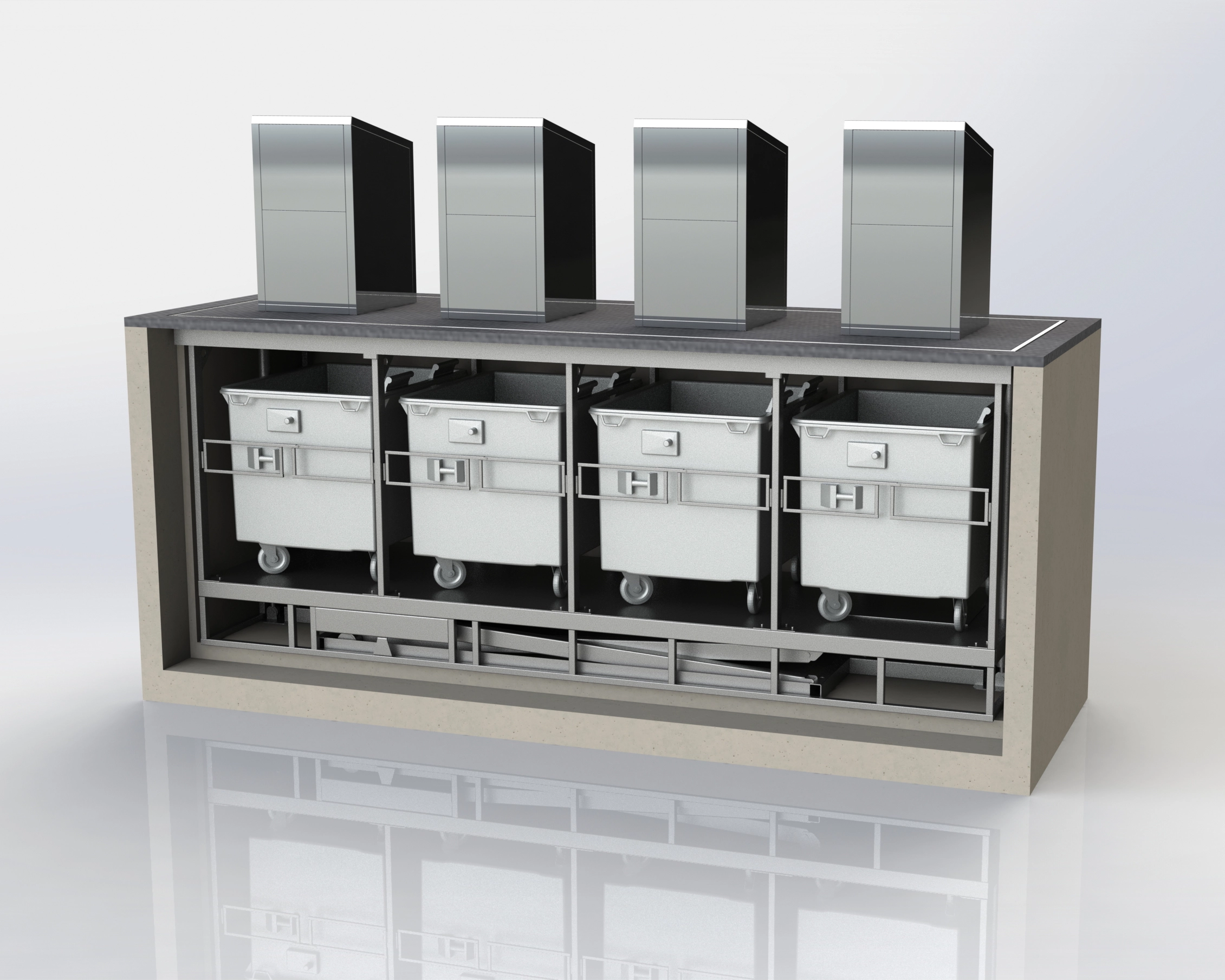
The design allows for the placement of 2, 3, or 4 standard containers in a concrete bunker, which protects them from weather conditions and unauthorized access. An additional advantage is space savings and the possibility of organizing household waste sorting directly on-site.
For the buyer
Such systems represent an investment in a technological and energy-efficient solution for the future. Efficient synchronization of hydraulic cylinders, the use of brake valves, and mechanical stabilizers ensure precision, safety, and stable operation.
The module is easy to maintain, adaptable to the specific needs of a site, and can be integrated into existing infrastructure. It is an optimal choice for residential complexes, developers, municipalities, and commercial organizations seeking to improve urban comfort and overall landscaping standards.
The underground waste storage module operates on a simple principle.
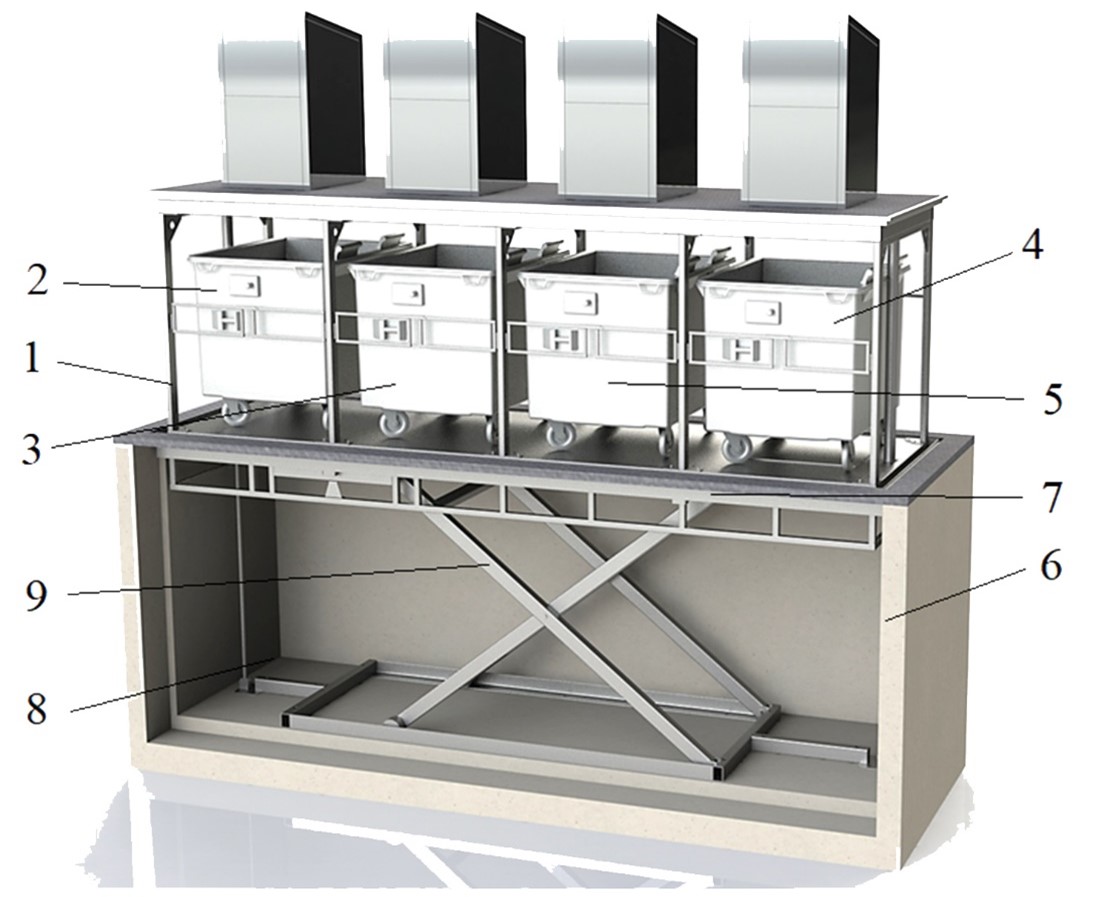
The platform (1) with 4 containers (2–5) is lowered into an underground concrete bunker (6) and remains there until fully filled. When the containers are full, the system sends a signal for the garbage truck to arrive, after which the platform is raised to the upper position for unloading. Once emptied, the containers are set back in place, and the hydraulic drive lowers the platform again.
Reliability and operational stability are ensured by the hydraulic system.
Two hydraulic cylinders raise and lower the platform, while a hydraulic power unit and brake valve are installed at its base, and metal tubes ensure tightness and safe operation. During movement, stability is maintained by a scissor-type lever mechanism (9), which keeps the platform in a horizontal position.